
How do I import my member list from a spreadsheet?
Bring an existing list in with a CSV file: the columns that are read, the preview you have to confirm, and why running the same file twice is safe.
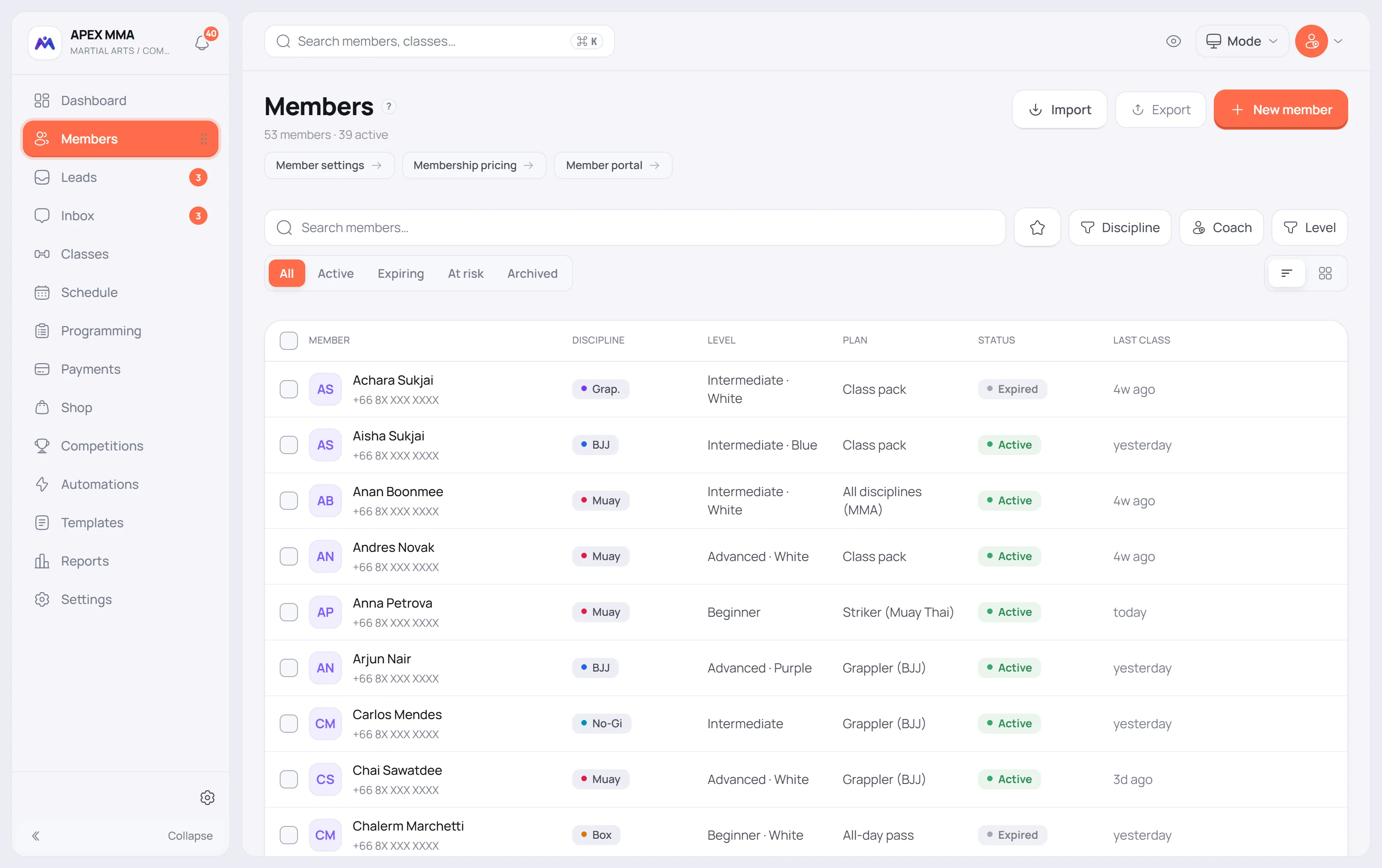
Members › Import
ขั้นตอน
- 1In your spreadsheet, use the headers from the downloaded template.
- 2Save the file as CSV.
- 3Open Members › Import and pick the file.
- 4Read the list of ignored columns in the Review window.
- 5Press Import to confirm.
หัวข้อในหน้านี้9
รู้ไว้จะดี
Where the button is, and who can use it#
Path: Members › Import (in the row of actions at the top, next to Export).
On a phone the button is not in that row. Open Filters, and Import members is at the bottom of the sheet.
Importing needs the Manage members permission. The owner, the admins and the front desk have it. A coach does not, by default.
The columns that are read#
The first line of the file must be a header line. Upper case, lower case, underscores and spaces around the names do not matter, and neither does the order of the columns.
These are read, and this list is complete: Name, Email, Phone, First name, Last name, Plan, Start, Renewal, Credits, Credits left, Status, Joined, Birthdate, Notes, Tags. Four more are accepted for a restore: ID, Plan label, Paid, Member status.
A name is the only thing every line needs. It can come from one Name column, or from First name and Last name as two separate columns, which the import joins into one name (you pick the order). When a file carries all three, Name wins. Lines with no name at all are left out and counted.
Running the same file twice is safe#
The import does not blindly create. For each line it looks for an existing member, first by ID if your file carries one, then by email, then by phone number. When it finds one, it UPDATES that member instead of making a second record.
The existing profile is used as the base, so a column your file does not carry is not wiped. Re-importing a file with only the phone numbers corrected keeps the LINE link, the consent date, the emergency contact and the join date of everyone it touches.
The same is true for memberships: a membership with the same plan and the same start date is not created twice.
The plan column accepts the name you read on screen
The Plan cell can hold either the internal key of one of your membership products or the label you see on screen. Both work, which is what makes an exported list re-importable.
When the cell matches, a membership is created with that plan, its price, its classes and its end date. When it matches nothing, the member is still created or updated, the line is counted as skipped, and no membership is attached.
Credits and Credits left are read as the total and the remainder. Paid accepts an amount, or simply yes to mark the plan settled at its catalogue price.
What the message at the end really counts
The report at the end counts what happened on the server, not the number of lines in your file: members created, members updated, rows not imported, then the memberships, plans and groups that were added.
A file is read up to five thousand lines. Above that, split it and import the parts one after the other.
Duplicates are answered before anything is written
Before the import starts, the preview lists every possible duplicate: several rows of your file sharing the same email, and rows that match someone already in your list.
Each one waits for your answer. For rows of the file: same person, one record; different people, one record each; or keep the first row only. For someone already in your list: update the existing record, create a new record, or do not import. One choice can answer all of them at once.
The Import button stays off while a duplicate has no answer, so nothing is written on a guess.
You can undo an import for 24 hours
For 24 hours after an import, Undo this import is offered in the report window and in the Import and export menu.
Members created by the import go to the trash with their history, and the memberships it created are removed. Records that already existed keep what the import changed, and plans and groups added to your settings stay.
A record that has been edited, booked or paid since the import stays unless you tick it in the undo window.
What an imported member looks like afterwards
The join date comes from the Joined column when your file has one. Without that column, the member is recorded as joining today, which shifts their seniority, your retention figures and any birthday or anniversary automation.
No waiver is signed. Every imported member lands in the Waiver missing count on the dashboard, which is the right place to work through them afterwards.
เมื่อมีปัญหา
Start from the template, not from a blank file
Path: Members › Template (the button next to Import and Export). On a phone it is Download template, at the bottom of the Filters sheet.
The template downloads with the exact headers the import understands and one example row filled with your own plan names. Fill it in, save it as CSV, and it loads back without a single rename.
The headers are in English on purpose. They are what the import matches on, so translating them breaks the round trip.